EV Two Wheeler Battery Charger Manufacturers in Pune | Rajashree International
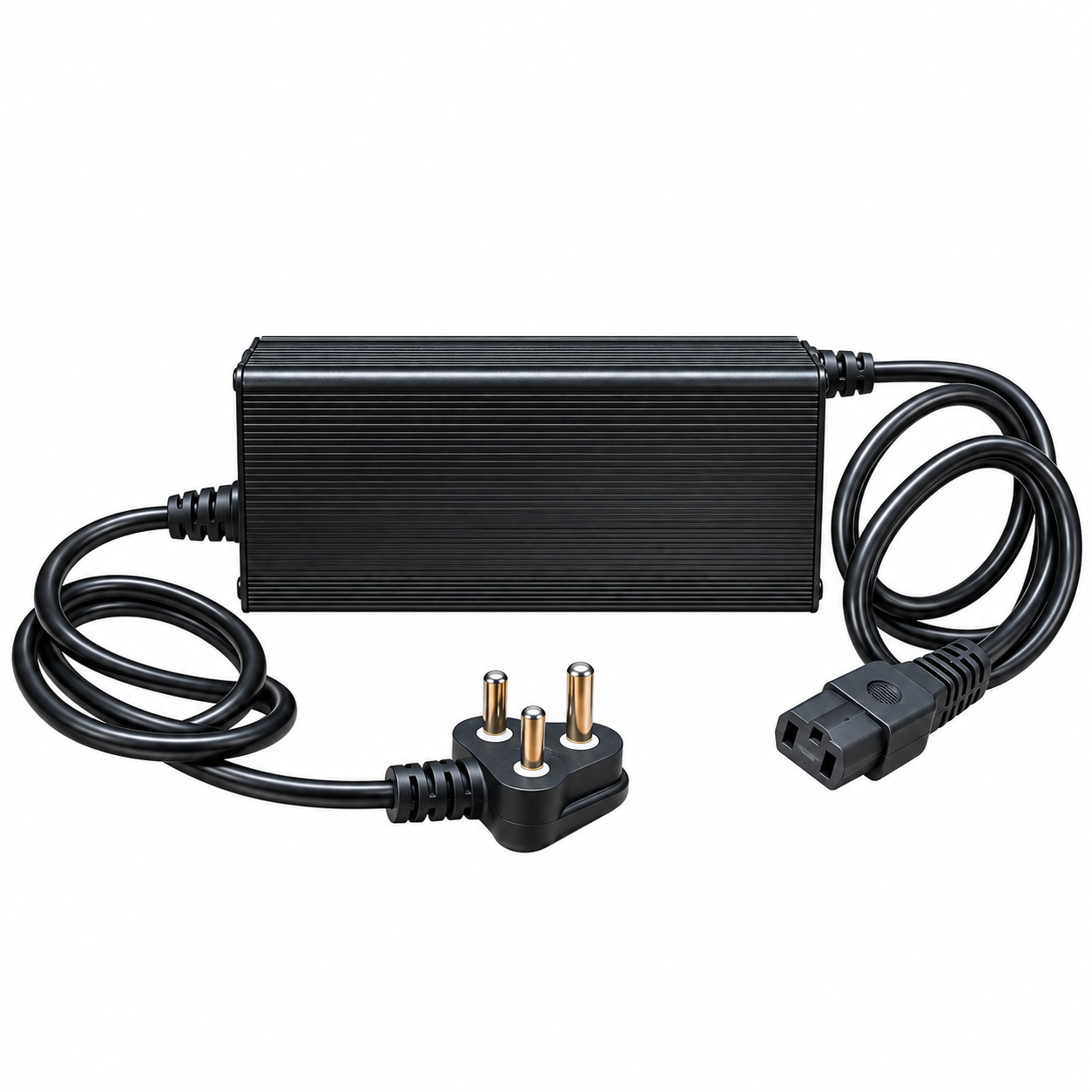


Rajashree International Manufacturing Pvt. Ltd. is leading EV Two Wheeler Battery Charger Manufacturers, Suppliers and Dealers in Pune. An EV Two Wheeler Battery Charger is an essential charging solution designed to safely replenish the battery of electric scooters and motorcycles. It converts electrical input into suitable charging power according to the battery's voltage, chemistry, and charging requirements.
An electric scooter battery charger provides controlled electrical energy while supporting efficient and reliable charging. Proper charger selection is important for maintaining battery performance, charging safety, and compatibility with the vehicle's electrical system.
Modern electric two-wheelers require charging systems that can meet different battery capacities, voltage levels, and usage conditions. We provide application-focused charging solutions designed around specific battery specifications and electric vehicle requirements.
Types of EV Two Wheeler Battery Charger
As we are leading EV Two Wheeler Battery Charger Manufacturers in Pune, our Types are designed to meet different application requirements and industry standards, including the following types:
- Electric Scooter Battery Charger: An electric scooter battery charger is designed to provide controlled charging for scooter battery packs while matching their required voltage and charging characteristics.
- Electric Bike Battery Charger: an electric bike battery charger supplies suitable electrical power to rechargeable battery systems used in electric motorcycles and other two-wheeler applications.
- Lithium Ion Battery Charger for EV: lithium ion battery charger for EV applications is designed to deliver controlled charging according to the characteristics and requirements of lithium-based battery packs.
- Fast Charger for Electric Scooter: fast charger for electric scooter applications is designed to provide higher charging power where the battery and vehicle system support faster charging.
- Standard Charger for Electric Scooter: standard charger for electric scooter applications provides a controlled charging rate suitable for routine and regular battery charging.
- Onboard Charger for Electric Two Wheeler: An onboard charger for electric two wheeler applications is integrated into the vehicle and converts external electrical input into a suitable battery charging output.
- Offboard Charger for Electric Two Wheeler: An offboard charger for electric two wheeler applications remains outside the vehicle and connects to the battery or charging interface during operation.
- 36V Battery Charger: a 36V battery charger is designed for compatible battery systems requiring a nominal 36-volt charging architecture.
- 48V Battery Charger: 48V battery charger is suitable for compatible electric two-wheeler battery systems designed around a 48-volt nominal configuration.
- 60V Battery Charger: 60V battery charger supports compatible battery packs used in electric scooters and motorcycles requiring this voltage class.
Detailed Process Description
A reliable charging solution involves several important stages to ensure appropriate electrical compatibility and controlled battery charging.
- Battery Requirement Analysis: we evaluate the battery chemistry, nominal voltage, capacity, charging current, connector arrangement, and vehicle requirements before selecting the charger configuration.
- Input Power Assessment: the available electrical supply is considered to determine suitable input requirements and ensure compatibility with the intended charging environment.
- Voltage and Current Configuration: Charging parameters are established according to the battery specifications to provide appropriate output voltage and current throughout the charging cycle.
- CC-CV Charging Control: Suitable CC CV charging technology can be incorporated for compatible lithium battery systems, allowing controlled constant-current and constant-voltage charging phases.
- Protection Integration: appropriate protection functions are considered to help manage conditions such as overcharging, short circuits, excessive temperature, and other electrical abnormalities.
- Connector and Interface Selection: the charging interface is selected according to the battery and vehicle configuration, ensuring secure electrical and mechanical compatibility.
- Testing and Verification: Chargers are evaluated for output performance, protection functions, electrical connections, and other applicable quality parameters.
- Final Inspection: The completed charging unit is inspected against specified requirements before being prepared for use or delivery.
Technical Specifications of EV Two Wheeler Battery Charger
As a trusted EV Two Wheeler Battery Charger Suppliers in Pune, we serve businesses across various industries that meet professional visual communication requirements.
| Parameter | Specification | Design Consideration | Component / Feature | Application |
|---|---|---|---|---|
| Input Voltage | Application-specific | Available AC supply | Input circuit | Two-wheeler charging |
| Output Voltage | Battery-specific | Battery voltage compatibility | Charging circuit | EV battery packs |
| Output Current | Application-specific | Battery capacity and charging requirement | Power electronics | Scooter and bike batteries |
| Charging Method | Application-specific | Battery chemistry | CC-CV / controlled charging | Compatible EV batteries |
| Connector | Customized | Battery and vehicle interface | Suitable charging connector | Electric two-wheelers |
Features and Benefits of EV Two Wheeler Battery Charger
As EV Two Wheeler Battery Charger Dealers in Pune, our products provide several Features and Benefits including consistent quality, smooth finish, and long service life.
| Features | Benefits |
|---|---|
| Battery-specific charging | Supports appropriate charging according to battery requirements |
| Controlled charging output | Helps maintain consistent charging performance |
| Protection functions | Helps protect the charger and battery from electrical abnormalities |
| Compact configuration | Supports convenient installation and use |
| Multiple voltage options | Allows application across different battery platforms |
| Connector compatibility | Enables suitable connection with different vehicle interfaces |
| Charging indicators | Provides users with useful charging status information |
| Application-focused design | Supports integration with different electric two-wheeler systems |
Applications of EV Two Wheeler Battery Charger
As EV Two Wheeler Battery Charger Manufacturers in Pune, our all types are used in various types of industrial sectors such as:
- 72V Battery Charger: a 72V battery charger is suitable for compatible higher-voltage electric two-wheeler battery systems where the vehicle and battery are designed for this voltage level.
- Battery Charger Voltage and Amperage: Battery charger voltage and amperage are selected according to the battery's electrical specifications, capacity, charging requirements, and vehicle architecture.
- Battery Charger Wattage Calculation: EV 2-Wheeler Battery Charger wattage calculation generally considers output voltage and current to determine the approximate charging power required for a particular application.
- Smart Battery Charger EV: a smart battery charger EV can incorporate controlled charging functions, monitoring capabilities, and protection features for compatible battery systems.
- Portable EV Battery Charger: a portable EV battery charger provides a convenient charging solution that can be transported and used in suitable charging environments.
- DC Barrel Connector Charger: A DC barrel connector charger can be used with compatible battery and charging interfaces where this connector configuration is specified.
- Battery Charger Connector Types: EV 2-Wheeler Battery Charger connector types vary according to electrical ratings, physical design, polarity, locking arrangements, and vehicle or battery requirements.
- Battery Management System Charger Compatibility: Battery management system charger compatibility is important because the charging system must work appropriately with the battery management and protection architecture.
- Overcharge Protection Charger: an overcharge protection charger incorporates suitable controls to help prevent charging beyond the specified battery limits when used with a compatible system.
- Short Circuit Protection Charger: a short circuit protection charger includes protective measures designed to respond to certain short-circuit conditions and help reduce electrical risks.
Why Choose Us?
- Application-Specific Solutions: we develop charging solutions according to battery chemistry, voltage, capacity, charging current, connector requirements, and vehicle architecture.
- Wide Voltage Support: our solutions can be configured for different battery platforms, including common electric two-wheeler voltage classes and application-specific requirements.
- Safety-Focused Design: we consider essential battery charger safety features such as electrical protection, temperature management, controlled charging, and suitable isolation requirements.
- Performance-Oriented engineering: our approach considers charging efficiency, power requirements, operating conditions, and battery compatibility to create dependable charging solutions.
- Quality and Compliance Focus: we consider applicable battery charger certification standards and relevant product requirements during charger development, testing, and final inspection.
Choose Rajashree International Manufacturing Pvt. Ltd. is leading EV Two Wheeler Battery Charger Manufacturers, Suppliers and Dealers in Pune. A properly designed charger is essential for maintaining safe, efficient, and reliable charging of electric two-wheeler batteries. From voltage and current selection to charging control, connector compatibility, and protection functions, every parameter needs to match the battery and vehicle requirements. With application-focused engineering and quality-oriented manufacturing, we provide charging solutions designed to support the growing requirements of electric scooters, motorcycles, and other electric mobility applications.
FAQs
Charging time electric scooter requirements depend on battery capacity, charger output power, charging efficiency, battery condition, and the charging strategy supported by the vehicle.
How to choose the right charger for electric scooter applications depends on battery voltage, chemistry, capacity, required charging current, connector type, and compatibility with the vehicle's charging system.
Battery charger input voltage refers to the electrical supply required by the charger, while the battery charger output voltage is the controlled voltage supplied toward the compatible battery.
A charger should only be used when its charging characteristics are compatible with the battery chemistry, voltage, capacity, BMS requirements, and manufacturer specifications.
A charger for high performance electric scooter applications should be selected according to the battery voltage, capacity, allowable charging current, thermal requirements, and manufacturer's recommended charging parameters.